


A new group has been launched to urge Iranian-Americans to vote for former President Donald Trump in the U.S. election.
The group, Iranians for Trump, describes itself as a grassroots campaign and was launched on September 3. It says that the administration of President Joe Biden and Vice President Kamala Harris has failed to confront Iran robustly. In contrast, Trump’s period in office was marked by a more aggressive stance toward the Middle Eastern nation, which escalated tensions significantly.
Those tensions were exacerbated by the attack on Israel on October 7, 2023, by militants from Hamas, the Palestinian group funded by Iran. The military campaign subsequently launched by Israel has become a major factor in the U.S. election, with prominent Democratic figures, including Harris, forced to balance historical support for Israel with pressure from pro-Palestinian elements in the party.
In early August, the Iranian government was revealed to have hacked the Trump campaign. A joint statement from the Office of the Director of National Intelligence (ODNI), the Federal Bureau of Investigation (FBI) and the Cybersecurity and Infrastructure Security Agency (CISA) said Iran sees this year’s election as particularly significant and sought to interfere through hacking and other activities.


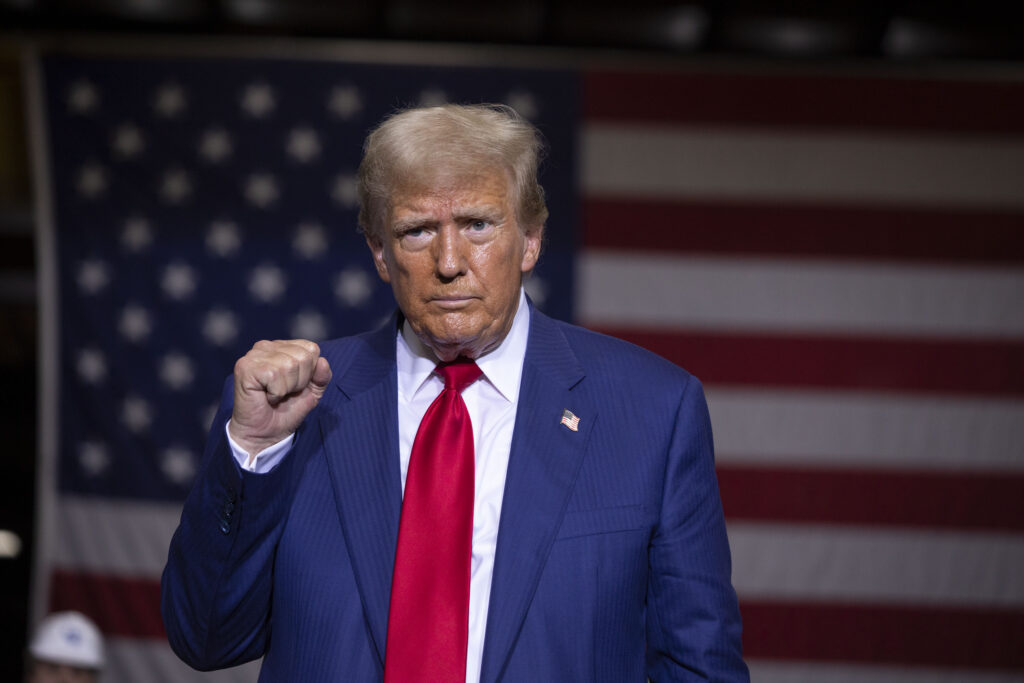
Former president Donald Trump speaking about the economy, inflation, and manufacturing at a campaign event on August 29 in Potterville, Michigan. The campaign group Iranians for Trump launched on September 3 and announced their support for the former president’s re-election campaign.
Bill Pugliano/Getty Images
Iran’s hacking does not solely affect Trump’s campaign but extends to those of Biden and Harris.
“Iran’s strategy in the field of information and propaganda is similar to how the Revolutionary Guards manage the proxy militias across the Middle East,” Amir Rashidi, director of digital rights and security at Miaan Group, a human rights organization focused on the Middle East, told The New York Times. “They infiltrate gradually but forcefully and play the long game.”
As a counterweight to this and what it sees as weakness toward the Iranian regime, Iranians for Trump was launched by Sarah Raviani, the English-language spokesperson for the group, and Nasim Behrouz, the Persian-language spokesperson for the group. It says it wants to improve global stability, and specifically stability in the Middle East.
Since its launch, the group has more than 3,000 followers on X, formerly known as Twitter, and its first post gained 201,000 views, 5,500 likes, and 1,500 re-posts.
Newsweek reached out to Iranians for Trump and the Trump campaign for comment via email.
Iranians for Trump was “founded on the principle that robust American leadership is crucial in addressing the oppressive actions of the regime in Iran,” according to the organization’s launch press release.
Behrouz said they are supporting Trump because, “While the Biden-Harris administration has struggled to effectively confront the threats posed by Iran’s regime, President Trump’s leadership is marked by unwavering commitment to safeguarding American national security and its resolute commitment to safeguarding American national security and supporting the Iranian people in their struggle for freedom.”
Raviani added, “Our mission is to mobilize our community to support leaders who continue to advance these crucial policies and ensure that American interests, as well as the aspirations of the Iranian people, are upheld.”
One of the most consequential actions taken by Trump toward Iran was the withdrawal from the Joint Comprehensive Plan of Action (JCPOA) in May 2018. Trump argued that the deal, which was designed to limit Iran’s nuclear capabilities, failed to adequately address Iran’s regional activities and missile program, and he believed it enriched the regime. Following the withdrawal, the administration reinstated economic sanctions.
Tensions escalated further with the U.S. assassination of Iranian General Qasem Soleimani, leader of Iran’s Quds Force, a division of the Revolutionary Guard, in January 2020. In a video following the campaign launch, Raviani said, “President Trump took a strong stance against the oppressive regime in Iran. He withdrew from the failed JCPOA, imposed maximum pressure sanctions, and designated the IRGC as a foreign terrorist organization.”
She added that his leadership allowed the Iranian people to protest against the regime and that he supported them.
John Ghazvinian, an expert about US-Iran relations, told Newsweek it was not surprising that some Iranian-American voters may favor Trump. Ghazvinian is also the executive director of the Middle East Center at the University of Pennsylvania.
“There is a strong contingent of Iranian-Americans who have been motivated very strongly for many years by their very strong feelings of antipathy for the Islamic Republic, that is a segment of the Iranian-American population that I think has been feeling much more emboldened recently and has been sensing the political winds blowing in their direction more than they have historically,” he said.
He added that for much of the 1990s and 2000s, the mainstream political analysis of US-Iran relations was dominated by a strain of thinking that suggested that some form of negotiation could be reached with the Islamic Republic. However, he noted in recent years that as relations between the US and Iran have hardened, both have moved into a more divisive posture.
“It’s not surprising that those who favor a more maximalist and confrontational approach to policy now feel that they are likely to be listened to much more, and they have a candidate who I think they feel represents their point of view,” he said.
He added, however: “It’s important to remember that Iranian-Americans, like any other group, are not a single-issue voting bloc, and there may be other reasons why some of these people like Trump as well.”
Following the Iranian Revolution in 1979, many Iranians emigrated to the United States, and between 1980 and 1990, the percentage of Iranians in the U.S. increased by 74 percent, according to the Migration Policy Institute.
According to the U.S. Census Bureau’s 2020 census, there were 413,842 people with Iranian ancestry reported living in the United States.
The Census Bureau’s 2020 report also noted that states with the largest Iranian populations included California, Michigan, New York, Texas, and Florida.
Do you have a story we should be covering? Do you have any questions about this article? Contact LiveNews@newsweek.com.
👇Follow more 👇
👉 bdphone.com
👉 ultraactivation.com
👉 trainingreferral.com
👉 shaplafood.com
👉 bangladeshi.help
👉 www.forexdhaka.com
👉 uncommunication.com
👉 ultra-sim.com
👉 forexdhaka.com
👉 ultrafxfund.com
👉 ultractivation.com
👉 bdphoneonline.com