
 By
By
On Chinese social media, stories of U.S. financial hardship have gone viral under the phrase “death line,” describing how many Americans are just one crisis away from poverty.
Why It Matters
Roughly 67 percent of Americans are living paycheck to paycheck, according to PNC Bank’s 2025 Financial Wellness report, while a Bankrate survey found 59 percent say they could not cover a $1,000 surprise expense.
These economic strains in the United States have become a topic of great interest in China, where people long viewed Americans as prosperous and the U.S. as an economic success story.
Although China’s social safety net remains limited, lower housing costs and stronger family support make such U.S. hardships appear starker by comparison. State-linked Chinese outlets have also amplified these conversations, characterizing U.S.-style capitalism as chaotic and brutal compared to China’s state-directed development model.
Newsweek has reached out to the U.S. State Department by email with a request for comment.
What To Know
An American blogger’s post about struggling to live in San Francisco on a $450,000 salary spread widely on Chinese social media. The discussion began on the lifestyle platform Xiaohongshu (Red Note) and quickly moved to Weibo, where users discussed it under a hashtag that translates roughly as “U.S. death line.”
“Death line,” referred to as some as the “kill line,” is a term in Chinese computer game lingo describing the point at which a player’s health is so low that they can be finished with one strike. Online, it has become a metaphor for Americans living so close to financial collapse that one accident, illness, or bill could “finish them off.”
The topic has drawn posts of surprise from some netizens and schadenfreude from others.
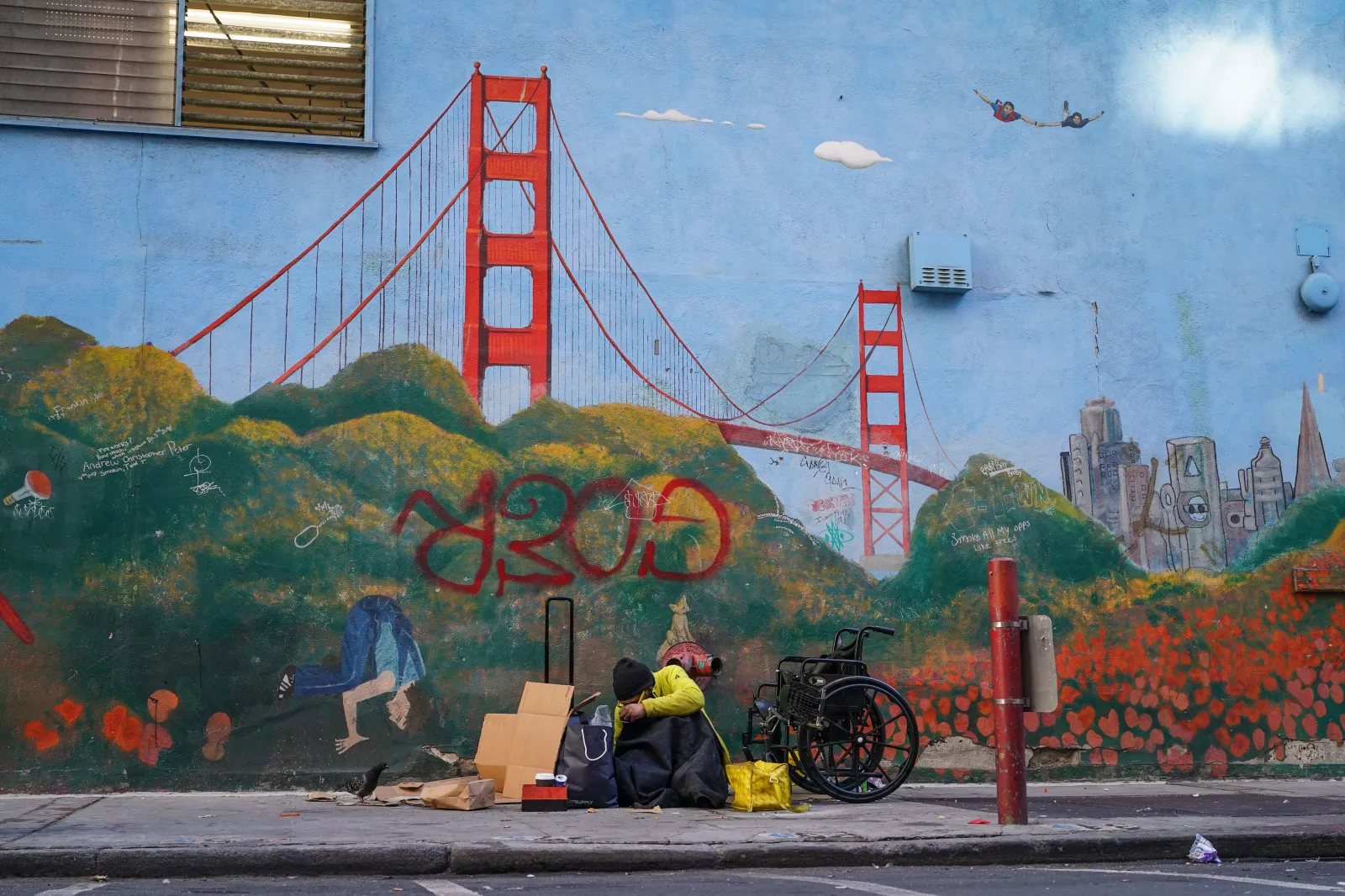
A long post by the Weibo user Qingqing Ledao, identifying herself as a longtime resident of Seattle, said that for families making less than $100,000 in total income, “life is very hard unless you have no rent or mortgage and don’t need medical insurance.” She added that “most Americans have no cushion—if they lose a job, fall ill, or divorce, they can quickly fall into crisis.”
The netizen also criticized what she called the country’s “extreme individualism,” arguing that it had dismantled traditional family support networks.
Yu Cixin, a finance columnist writing on the commercial portal NetEase, wrote that in the United States “a stable residence is the basic condition for keeping a job,” and that after losing employment and the ability to pay rent, “most people become homeless within a short time.”
She contrasted this with China’s social safety net, writing that Chinese people “find the ‘Death Line’ hard to understand” because the country has what she called a ”minimum-guarantee line’ providing basic welfare assistance.
China has a minimum-income allowance known as the dibao that provides small, means-tested cash payments to households below local poverty thresholds. The aid is not automatic, however, and many migrant and informal workers are excluded because eligibility depends on local registration.
What People Are Saying
Lizzi Lee, a fellow at the Asia Society Policy Institute’s Center for China Analysis, wrote on X: “Ultimately this is a U.S. vs. China service-cost problem. With globalization and new technology, goods (food, appliances, electronics etc.) in the U.S. have gotten much cheaper. But labor-intensive services (housing, healthcare, education, childcare etc.) have gone in the opposite direction. And for many families, these are not optional services… And when something goes wrong, the costs pile on all at once.
“Of course, there are many gaps and underdeveloped areas, esp. in rural regions [in China], and in many respects China’s formal social welfare system is much weaker than that of the U.S. But informal social structures, especially family support, combined with lower service prices, create a kind of basic buffering that makes the system feel at least in some ways less brittle…”
The White House wrote in a November 18 post on X: “”The Biden administration started the affordability crisis, but President [Donald] Trump will end it so all Americans can achieve economic prosperity.”
What Happens Next
Millions of Americans living on the edge are expected to feel a new strain as the Trump administration’s policies take effect.
The One Big Beautiful Bill Act, signed into law in July, cut more than $1 trillion from health programs—the largest reduction of federal health funding in U.S. history. Health care advocates warn it could leave up to 10 million people without coverage.
The Trump administration has defended the move as an effort to reduce waste and promote self-sufficiency, introducing new provisions that require recipients to work in order to receive benefits.
👇Follow more 👇
👉 bdphone.com
👉 ultractivation.com
👉 trainingreferral.com
👉 shaplafood.com
👉 bangladeshi.help
👉 www.forexdhaka.com
👉 uncommunication.com
👉 ultra-sim.com
👉 forexdhaka.com
👉 ultrafxfund.com
👉 bdphoneonline.com
👉 dailyadvice.us