
 By
By
Each year, billions of dollars in corporate funding go unclaimed simply because nonprofits do not know the opportunities exist. For many organizations, the hunt for a corporate grant database is the first step toward moving away from accidental revenue and toward a predictable fundraising strategy.
Whether you run a small local school or manage a sizable international charity, having a central hub for researching corporate giving prospects is no longer a luxury. It is a necessity in a world where CSR is becoming a core function of business operations.
The following guide includes everything you need to know to choose the right database solution for your team. We’ll cover:
Securing corporate support requires more than a great mission. It requires the right data to identify businesses whose values and opportunities align with your own.
By the end of this review, you should have a clear understanding of the top tools on the market, along with a step-by-step plan for selecting one that fits your budget and goals. Let’s begin.
What is a corporate grant database?
A corporate grant database is a digital library that stores information on businesses that give back to nonprofits. Unlike a standard search engine, these tools are curated specifically for fundraisers. They provide details you cannot always find on a company website, such as a history of past giving, specific grant eligibility requirements, and direct links to application forms.
While many people think of grants as simply “check writing,” corporate giving is actually a much broader expanse. A robust database will help nonprofits locate corporate grants, in-kind donations, workplace giving programs, and more. The goal is to reduce the hours your staff spends on manual research so they can spend more time building relationships with grant-makers.
Did You Know? According to recent data from Giving USA, corporate philanthropy rose 9.1%, reaching $44.4 billion. Still, many nonprofits struggle to capture this revenue, in part due to a lack of awareness regarding available opportunities. That’s where a database tool comes in!
5 leading corporate grant databases to consider
There are several options when it comes to corporate grant databases, and selecting the right one for your nonprofit can mean the difference between uncovering the best funding sources and leaving available revenue on the table.
Here are re: Charity, we took the liberty of reviewing the five most commonly used database tools so that organizations like yours can make a better-informed decision. Let’s take a look at our findings!
1) Double the Donation: the leading corporate giving resource
Double the Donation offers the most extensive corporate grant database for nonprofits and schools seeking to increase revenue through corporate giving. As a premier fundraising tool, the platform is designed to help organizations of all shapes and sizes tap into the massive potential of corporate philanthropy without the manual heavy lifting.
Offering a comprehensive directory of philanthropic companies, Double the Donation makes it easy for organizations to identify and access corporate funding. The search functionality is designed to be intuitive so that any staff member or donor can find the information they need in seconds.
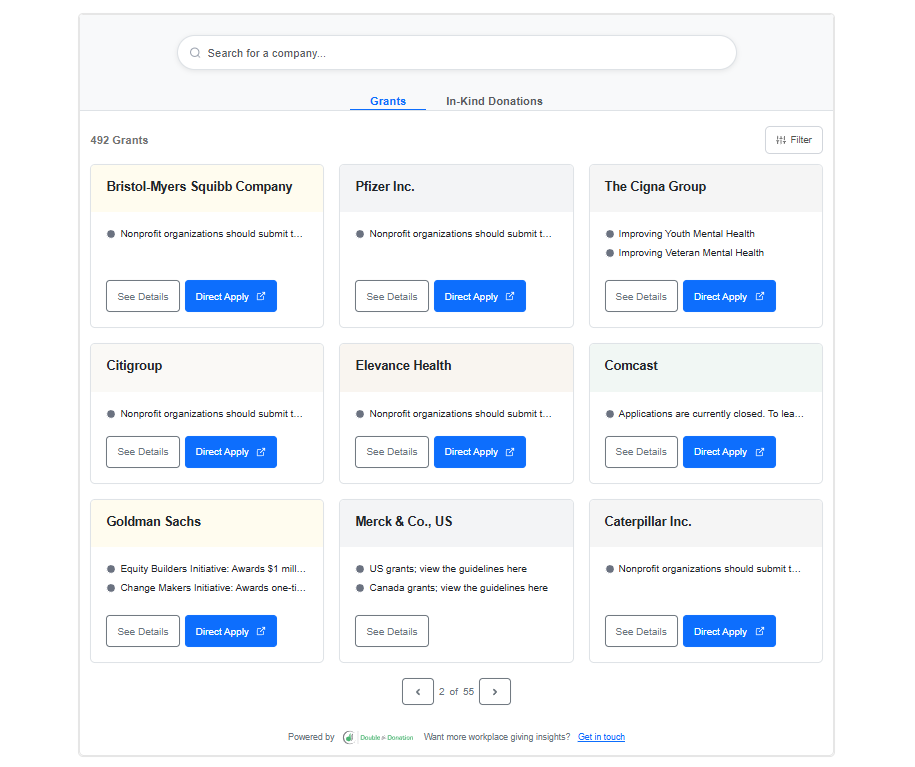
How Double the Donation’s corporate giving database works
The user experience is streamlined to keep the path from discovery to application as short and simple as possible. Here is how the process typically looks:
- A user clicks into the database search tool and begins typing a company name.
- The user selects the appropriate company from the auto-completing dropdown menu.
- The user is then provided with company-specific information regarding available grants and other giving programs in real time (such as funding amounts, application processes, deadlines, and even relevant contact information).
This generally includes eligibility guidelines and links to application forms for easy access. With program information for thousands of companies, the database tool ensures that organizations never miss out on valuable corporate support.
What programs are included?
Double the Donation’s corporate giving database is designed to help nonprofits connect with a wide range of philanthropy programs. With a recent major expansion, the database now uncovers even more opportunities for organizations to secure corporate funding and support, including:
- Corporate Grants: Businesses offer direct grants to nonprofits through annual initiatives or employee-nominated programs.
- In-Kind Donations: Companies contribute goods, services, or other non-monetary resources to assist organizations in cutting costs.
- Matching Gifts: Corporations match their employees’ donations to eligible nonprofits, effectively doubling (or sometimes tripling) the original contributions.
- Volunteer Grants: Employers provide financial donations to nonprofits where their team members volunteer, rewarding community involvement with direct funding.
The database currently contains insights into thousands of companies’ programming and is updated regularly through a combination of corporate website scraping, direct partnerships with CSR vendors, and primary research conducted in collaboration with community relations departments and nonprofit clients.
Learn more about Double the Donation’s corporate grant database here.
2) Candid Foundation Directory: broad foundation research
For decades, the Foundation Directory (now part of Candid) has been the go-to resource for deep-dive funding research. It is known for its massive scale, covering hundreds of thousands of grantmakers. While it includes many private foundations, it’s also an excellent corporate grant database for identifying corporate funders.
The strength of Candid lies in its data. You can see exactly who a company has funded in the past, the average gift size, and the geographic regions they prefer. This level of detail is vital for vetting a prospect before you spend time on an application.
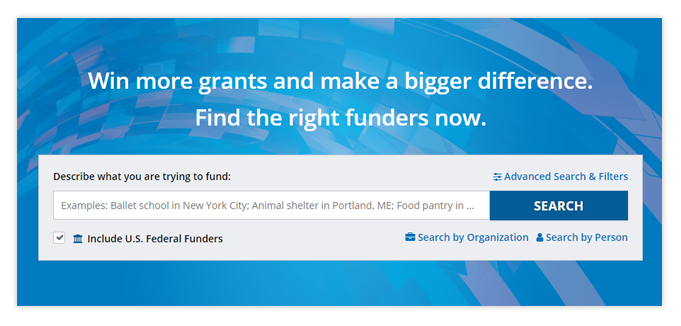
One unique aspect of Candid is its accessibility. While the professional version is a paid subscription, Candid partners with libraries and community centers across the country to offer free access to the platform. This makes it a great starting point for small nonprofits that are just beginning their grant research journey.
Learn more about Candid’s corporate grant database here.

3) GrantStation: small nonprofit grant insights
If your organization is looking for a budget-friendly corporate grant database, GrantStation is a strong contender. It offers a searchable database of thousands of grantmakers in the United States, Canada, and abroad.
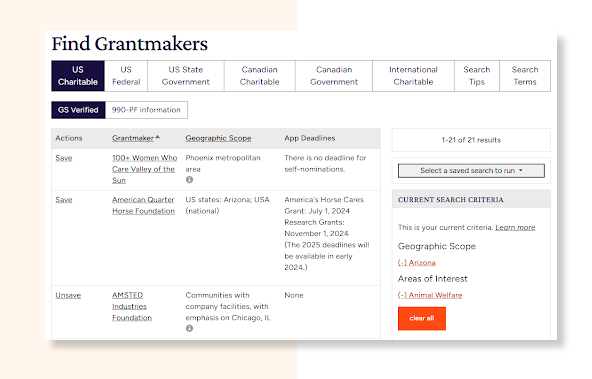
In order to aid busy nonprofit fundraisers, GrantStation focuses on providing easy-to-read profiles. Rather than overwhelming you with raw data, the tool summarizes the most important parts of a funder’s guidelines. This is helpful for already-stretched-thin executive directors who might be doing their own grant writing.
They also offer a variety of “how-to” resources, including intuitive grant writing tutorials and useful templates. Many nonprofits access GrantStation through a membership with a state association of nonprofits, which often provides the tool at a deep discount and makes it even more of an affordable option.
Learn more about GrantStation’s corporate grant database here.
4) GrantWatch: active grant opportunity tracking
GrantWatch is slightly different from other databases because it focuses heavily on “active” or “open” grants. While other tools might show you every company with a giving program, GrantWatch highlights those with a current request for proposals (RFP) or an upcoming deadline.
The search filters are also very specific. You can filter by “interest” (such as arts, education, or veterans) and by “location” (down to the specific state or territory). This makes it a useful corporate grant database for identifying local grant opportunities that might not appear in larger, more general directories.
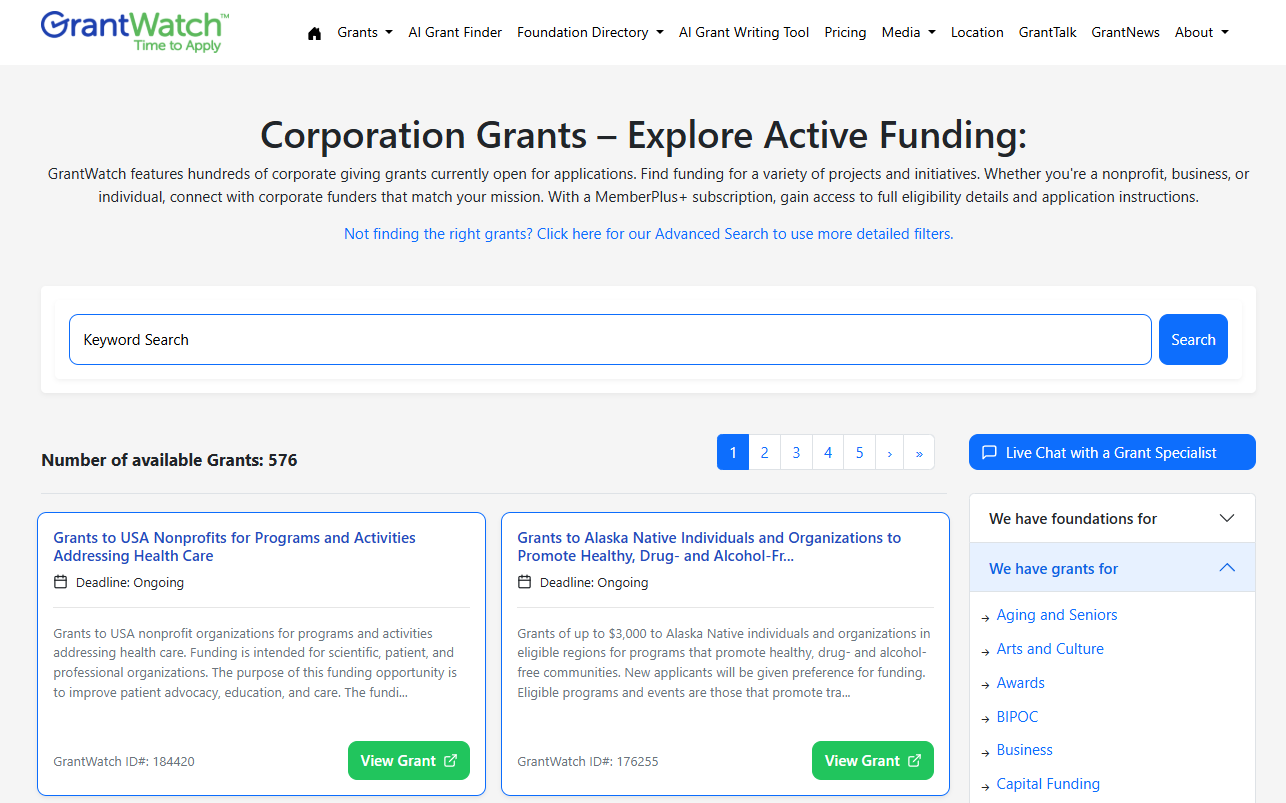
GrantWatch is often used by smaller community organizations and schools because it allows you to see the most urgent opportunities first. It is a straightforward tool that gets right to the point: who is giving money right now, and how do you apply?
Learn more about GrantWatch’s corporate grant database here.

5) Instrumentl: automated grant management
Instrumentl has quickly become a favorite for professional grant writers because it combines a corporate grant database with a project management system. It does not just give you a list of names; it actually matches your specific projects to potential funders to whom you’d likely appeal.
When you set up a project in Instrumentl, you provide details about your location, your field of work, and your funding needs. The software then scans its database of over 400,000 funders to find the best matches for your unique case. This includes corporate funders, private foundations, and even federal and state government grants.
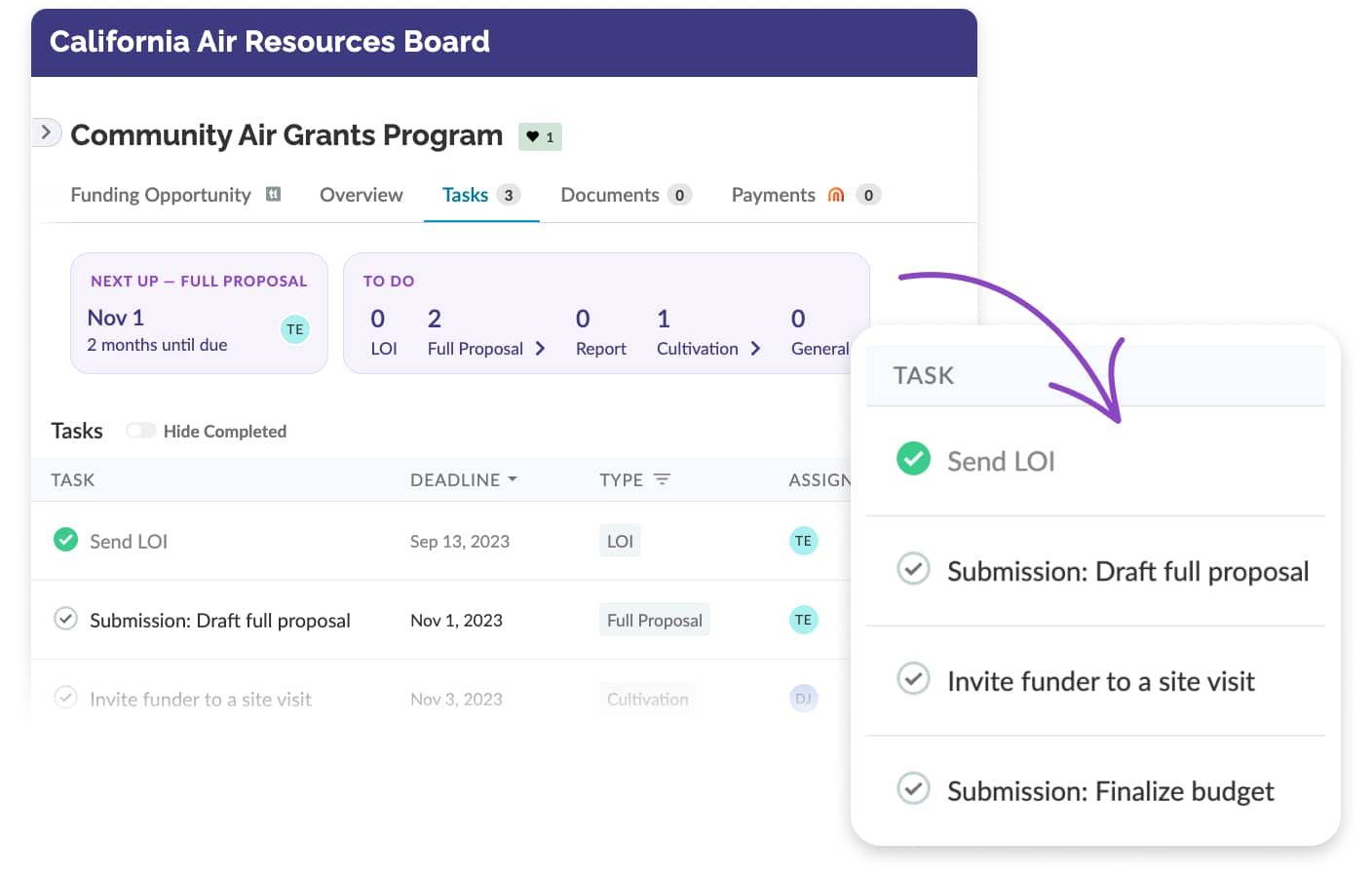
The platform is particularly helpful for tracking deadlines, providing a centralized calendar through which you can see all of your upcoming submissions. If a funder changes its deadline or updates its Form 990, Instrumentl will send you an alert. This proactive approach saves hours of manual checking.
Learn more about Instrumentl’s corporate grant database here.
How to vet a corporate grant database for your nonprofit
With so many options available, choosing the right database for your grant research can feel overwhelming. To find the best fit, we recommend evaluating each platform based on a few specific factors.
- Examine the size and type of the database: Start by looking at what the data actually covers. Does it focus more on private foundations or corporate giving? If your goal is to grow workplace giving revenue, you need a specialized fundraising tool like Double the Donation. If you are looking for large multi-year foundation grants, a more archival tool might be a better fit.
- Consider the user interface and ease of use: If the software is too complex, your team may not use it. Therefore, look for tools that offer automated processes, such as match alerts or auto-complete search bars. These seemingly small features can save significant time over the course of a year and help ensure your staff stays productive.
- Look for robust reporting and tracking: Since more than more than 50% of nonprofits view revenue as the key metric of success, your database should make it easy to see where your money comes from. Choosing a tool with clear reporting helps you demonstrate the software’s value.
- Evaluate the cost versus the potential return on investment: A database that costs $1,000 a year might seem costly, but if it helps you secure just one $5,000 corporate grant, it will have already paid for itself.
When you take the time to vet your tools properly, you ensure that your fundraising team has the best possible resources to meet their goals. Using a high-quality corporate grant database allows you to move away from guesswork and toward a data-driven approach to funding.
Corporate grant databases: Frequently asked questions
Still have questions? We’ve compiled answers to some of the most common questions about corporate grant database solutions.
How often are corporate grant databases updated?
The frequency of database updates varies significantly depending on the provider and the technology it uses. Because corporate giving policies change continuously, data accuracy is a moving target. However, high-end database tools typically refresh their data daily or weekly, while smaller directories may only be updated once or twice a year.
Top tip: If you find a discrepancy between a database and a company’s own website, prioritize the company’s official documentation and notify the database provider to help improve the tool.
Can small nonprofits use these tools?
Certainly. In fact, small nonprofits often benefit the most because their teams are more limited in time and resources, and require the efficiency that a corporate grant database provides. Many tools even offer tiered pricing to accommodate smaller budgets.
Do I need a grant writer to access a database?
Not necessarily! While a professional grant writer can help you craft the perfect proposal, the databases themselves are designed to be user-friendly so that any development director or volunteer can use them.
What’s the difference between a foundation database and a corporate grant database?
A foundation database typically focuses on private and family foundations that distribute funds to meet legal requirements. These grants are often larger and highly competitive, requiring complex narratives and multi-stage applications.
In contrast, a corporate giving database focuses on the philanthropic side of businesses. These often include standard corporate grants as well as workplace or employee-led giving programs like matching gifts, which are driven by donor connections rather than formal funding applications.
Wrapping up: choosing your path to corporate revenue
Finding the right corporate grant database for your nonprofit’s needs is one of the most essential investments you can make. Regardless of the platform you choose, the key is to stop guessing and start using data to drive your strategy.
Remember: corporate partnerships are about more than just a single check. They’re about building a community of support around your mission. When you have the best tools, you can spend less time searching and more time making a difference.
Ready to unlock more corporate funding?
Learn how Double the Donation can help.
👇Follow more 👇
👉 bdphone.com
👉 ultractivation.com
👉 trainingreferral.com
👉 shaplafood.com
👉 bangladeshi.help
👉 www.forexdhaka.com
👉 uncommunication.com
👉 ultra-sim.com
👉 forexdhaka.com
👉 ultrafxfund.com
👉 bdphoneonline.com
👉 dailyadvice.us