
 By
By
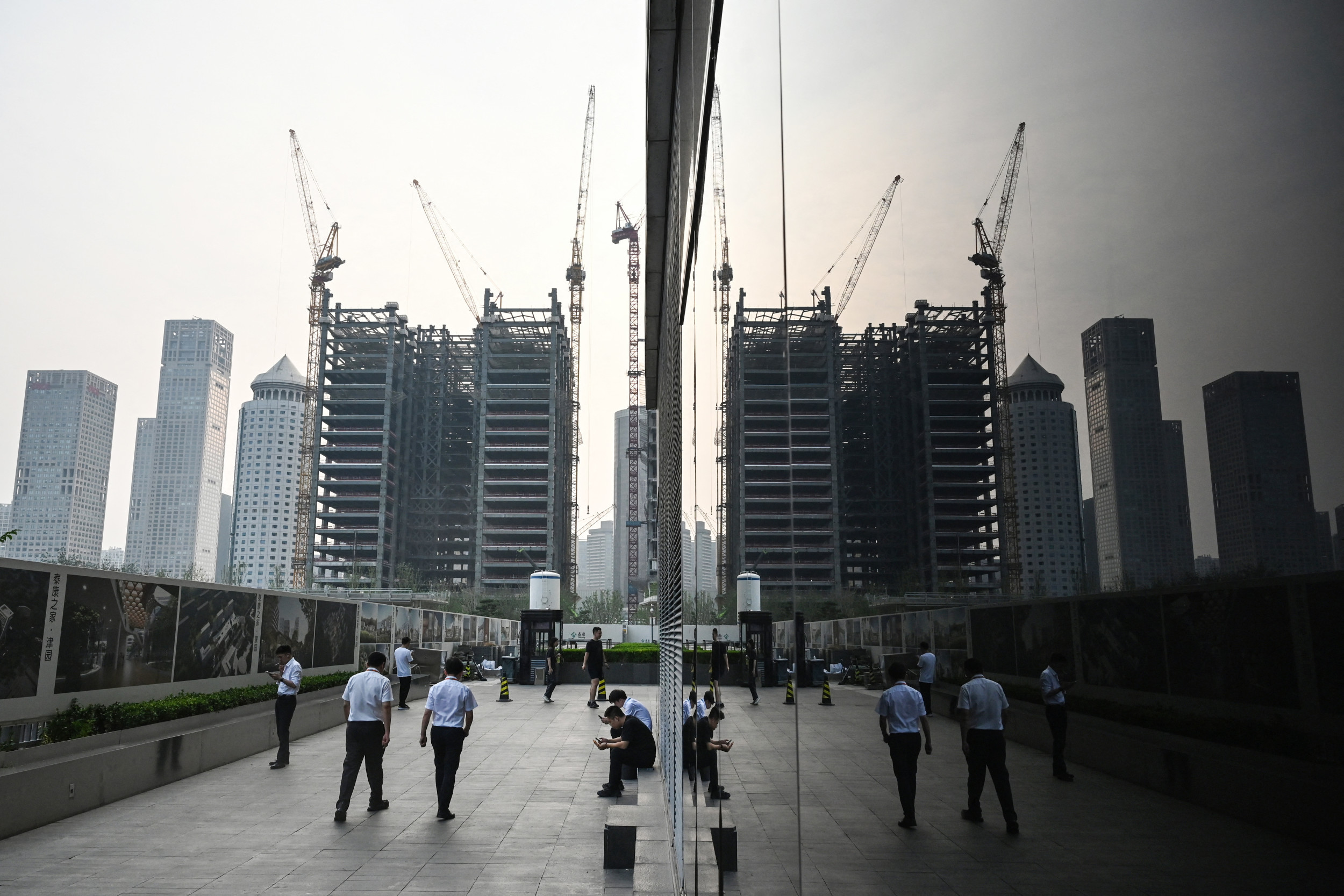
The Chinese government’s efforts to stabilize its struggling property sector have failed and the industry’s problems are likely to continue putting downward pressure on the country’s economy, experts have told Newsweek.
In recent months, particularly following April’s meeting of the Chinese Communist Party’s powerful Politburo, there have been attempts to stabilize the nation’s property market after it was thrown in disarray in 2021 when real estate giant Evergrande Group defaulted on interest repayments.
But despite the introduction of measures, which included reducing down-payment requirements in some places, getting rid of the floor of mortgage rates and easing purchase restrictions, “there’s still no evidence that these measures are doing anything near enough to stabilize the market,” David Lubin, the Michael Klein Senior Research Fellow in the Global Economy and Finance Programme at Chatham House think tank, told Newsweek.
“It doesn’t feel like there’s been any real improvement in the real estate sector in China,” Lubin said. “In June, the total 70-city average indicator of property prices declined by 7.9 percent year-on-year. It was the biggest decline in annual terms on record.”

GREG BAKER/AFP via Getty Images
“The housing market crisis has been intensifying in both the newly built and, especially, the secondhand markets in the past 12 months,” Professor Kent Deng, reader in economic history, director of China in Comparative Perspective Network and co-director of the Confucius Institute for Business London at the London School of Economics, told Newsweek.
“What we see is that prices in these two submarkets have dropped by at least 40 percent respectively and there is no sign to stop that trend,” he added. “Realistically, the price level is likely to drop by a further 10-20 percent before stabilizing.” According to Deng, the Chinese housing market downturn might continue “until the end of 2025.”
Deng agreed that the Chinese government’s plans to overcome the current crisis have failed. “The government has tried to make housing price drop illegal by law. Even so, a growing number of mortgage holders have failed to fulfill mortgage obligations,” he said.
“As a result, banks are forced to auction these properties in arrears with mortgage payments at bargain basement prices. This in turn has undermined government price control largely due to the fact that all mortgage-lending banks are also state-owned,” Deng said. “It is clear that government banks are having the upper hand, which has made the said law [have] no teeth.”
Newsweek emailed the Chinese embassy in the U.S. for comment on this story.
Shifting the Chinese Economy
According to Lubin, Beijing is not trying to reinvigorate the property market. “I think Chinese economic policy is governed by, in this respect, one major objective, which is to fundamentally and permanently reduce the economy’s reliance on real estate investments,” he said.
“There’s a kind of pure economic aspect to this strategy,” he added. “It’s just nuts to have so many eggs in one basket. It’s nuts that so much of Chinese GDP was generated by real estate investment.” He added that GDP in China had become too dependent on this, and that from this point of view it makes sense to diversify the economy away from real estate.
But there’s another explanation behind the desire to refocus the Chinese economy away from the property sector—and it has a lot to do with geopolitics, the experts said.
“In an environment in which China feels threatened by the risk of sanctions, by trade policy actions and industrial policy actions that are designed to constrain the Chinese economy, Beijing is trying to reduce its reliance on real estate investment to free up capital and credit resources that they can then migrate to other kinds of economic activities that they think these days are more strategically important,” Lubin said, “namely semiconductors and technology, A.I., biopharma, green energy, agricultural efficiency.”
Through this potentially painful shift, the country wants to increase its self-reliance so that it would be able to withstand the shock of any potential coordinated sanctions from the West in the future.
This goal puts China’s efforts to stabilize its property sector into perspective. “The Chinese authorities have failed to deliver anything like a kind of game-changing fiscal stimulus, and they failed to loosen monetary policy in any meaningful way,” Lubin said.
“And I think that that failure can be understood by taking geopolitics into account. If you’re worried about geopolitical risk, then what you want to do is not to have a consumer-driven economy; they want to keep Chinese citizens frugal and disciplined.”
What Other Solutions Could Beijing Implement?
Lubin cannot imagine what’s next for Beijing, as the government has not made its plan to fix the sector clear. “I can’t really imagine that there’s a hell of a lot else they can do,” he said. “One of the things that constrains the Chinese government is the country’s public debt.”
According to the International Monetary Fund (IMF), China’s augmented public debt stock last year—which included government debt and off-balance sheet public sector debt—was 116 percent of GDP.
“[Chinese President] Xi Jinping famously said in 2017 that financial stability is a key element of national security,” Lubin said. “And because of the unwillingness to create financial vulnerability, China is unwilling to loosen fiscal policy. So, one easy option—which would be to have the state buy up a bunch of properties—is just not available, because the government is very unwilling to loosen fiscal policy.”
More Struggles Ahead
Meanwhile, the Chinese economy is still struggling. Deng said that “there are two obvious components of the Chinese economy going badly simultaneously,” which he said were the property market and its heavy dependence on exports.
“Ideally, China will cut back its exports and turn its attention to its domestic market,” Deng said. “But it means shutting down 30 percent of China’s GDP and causing a large rate of industrial unemployment. When you factor this in China’s property market, more people will go bankrupt after losing their jobs and hence more mortgages will be in arrear, predictably.”
“In economics, we call this the dilemma of ‘corner solution in a production possibility frontier,'” Deng said, adding that this means that a country’s economy “faces a dead end.”
👇Follow more 👇
👉 bdphone.com
👉 ultraactivation.com
👉 trainingreferral.com
👉 shaplafood.com
👉 bangladeshi.help
👉 www.forexdhaka.com
👉 uncommunication.com
👉 ultra-sim.com
👉 forexdhaka.com
👉 ultrafxfund.com
👉 ultractivation.com
👉 bdphoneonline.com