 By
By
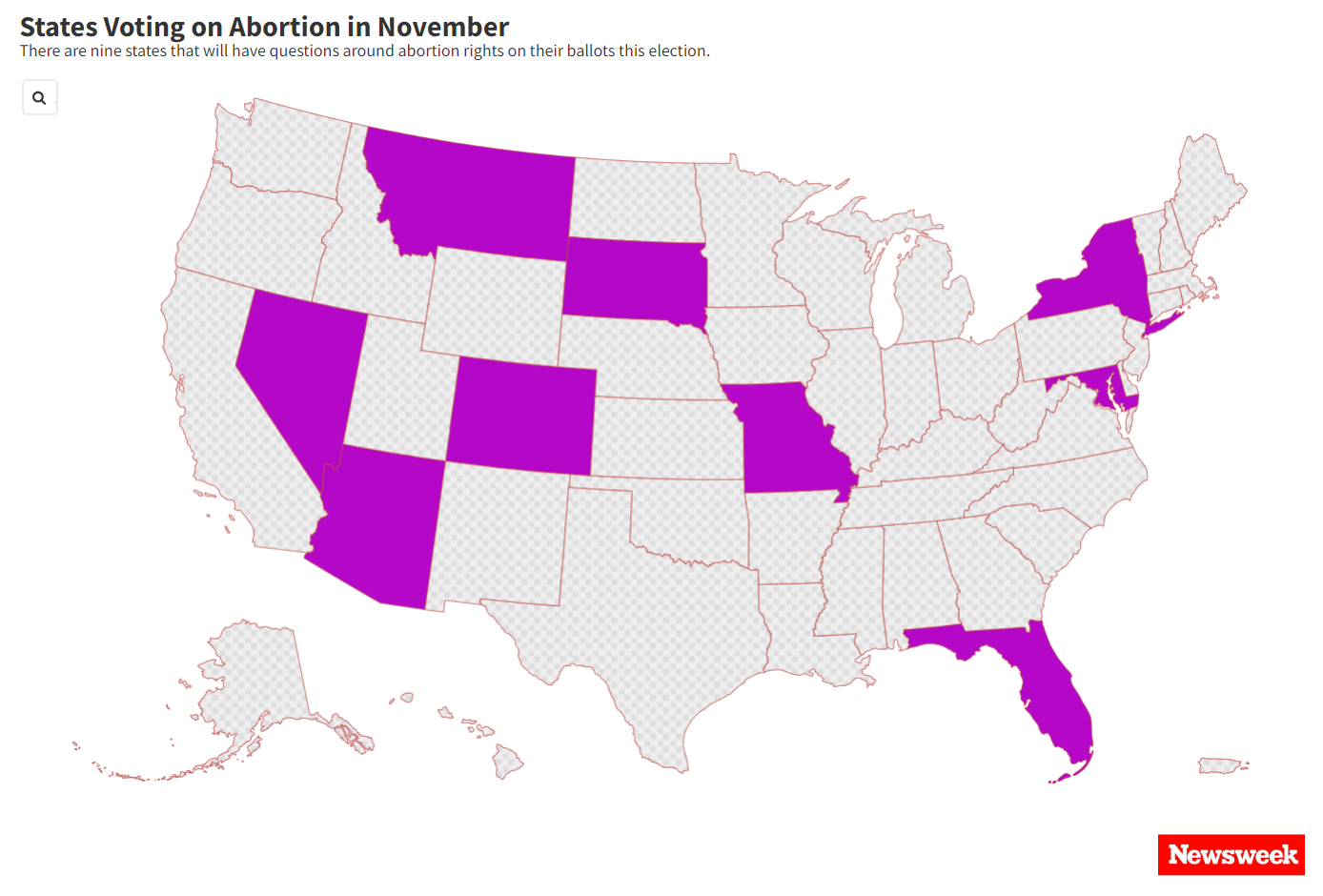
There are nine states — including two critical swing states — that will vote on abortion rights in November, as Arizona and Montana joined the list late Tuesday night.
Election officials in those states announced this week that abortion-rights supporters have gathered enough petition signatures to propose amendments to their states’ constitutions.
Since the Supreme Court overturned Roe v. Wade in the landmark Dobbs decision two years ago, a growing number of states have responded by passing their own laws codifying the right to abortion.
Post Dobbs, some Republican-controlled states have passed their own abortion restrictions, with a ban on abortion at every stage of pregnancy now the law of the land in 14 states. Meanwhile, most Democratic-led states have passed legislation that protects access to abortion.
These are the states that will put the question to their voters in November.

Montana
As of Tuesday, voters in Montana will now have an abortion referendum on their ballots in November.
The Montana Secretary State’s Office certified that the ballot will include the abortion rights initiative. It seeks to enshrine a 1999 Montana Supreme Court ruling that gave the constitutional right to privacy including for pre-viability abortions.
Republican Attorney Gen. Austin Knudsen initially determined the proposal was legally insufficient. The Montana Supreme Court overruled him.
Knudsen rewrote the ballot language to say the proposed amendment would “allow post-viability abortions up to birth,” eliminate “the State’s compelling interest in preserving prenatal life” and potentially “increase the number of taxpayer-funded abortions.”
Arizona
The Arizona Supreme Court ruled on the same day that a summary that abortion advocates used to collect signatures for a ballot measure is valid. This clears the path for voters in that state to decide on abortion in November.
The measure would allow abortions until an embryo or fetus could survive outside of the womb. That is typically around 24 weeks after conception.
The Arizona Right to Life movement had argued the petition summary was misleading.
The court decision came very close to the Thursday printing deadline for the Arizona ballot.
“We have noted that “(r)easonable people can differ about the best way to describe a principal provision, but a court should not enmesh itself in such quarrels,” the court wrote in its ruling.
Currently, abortion is legal in the state for the first 15 weeks of pregnancy.
Missouri
In November, Amendment 3 will ask Missourians if they want to legalize abortion up until the point of fetal viability. Secretary of State Jay Ashcroft, a Republican, certified the measure for the ballot last week.
Abortion has been illegal in Missouri, with limited exceptions, since June 2022.
Backers, however, are calling the ballot language, which was written by Ashcroft, “unfair” and “misleading.”
The language listed on the secretary of state’s website reads: “A ‘yes’ vote will enshrine the right to abortion at any time of pregnancy in the Missouri Constitution. Additionally, it will prohibit any regulation of abortion, including regulations designed to protect women undergoing abortions and prohibit any civil or criminal recourse against anyone who performs an abortion and hurts or kills the pregnant women.”
Abortion-rights advocates are asking the courts to re-issue the fair ballot language.
Colorado
Abortion is currently legal at all stages of pregnancy in Colorado after state lawmakers passed a bill that guarantees abortion access in 2022. That, however, could be overturned by a majority vote in the General Assembly or by a ballot measure at any point.
Voters in November will have the decision to enshrine the protections in the state constitution.
The initiative would also lift the state’s 40-year ban on state money being used to pay for abortions.
Support from 55% of the state’s voters is needed to amend the state constitution.
Maryland
Similar to Colorado, voters in Maryland will decide whether to enshrine the right to abortion in the state’s constitution.
In 2018, State Speaker of the House Michael Busch endorsed efforts to codify the right to an abortion in the state constitution, noting fears that the Supreme Court would overturn Roe. Adrienne Jones, who was elected house speaker in 2019, continued Busch’s efforts and the legislation was passed in a 93-42 vote.
Nevada
Abortion is currently allowed up until viability in Nevada. In November, voters will consider an amendment to enshrine abortion access for the first 24 weeks of pregnancy, with later term abortions allowed when protecting the health of the mother.
The Nevadans for Reproductive Freedom movement announced they submitted over 200,000 signatures for the measure to be on the ballot. Only 102,000 were needed.
“We can’t take anything for granted in a post-Dobbs world and that’s why we are really doubling down on the protections we have in statute currently,” said Lindsey Harmon, the group’s president.
Voters will need to approve the measure in both 2024 and 2026 for it to change the state’s constitution.
Florida
In April, Florida’s State Supreme Court ruled a measure to legalize abortion until viability could appear on the ballot, even though it has gone through a series of legal challenges.
The Florida Supreme Court most recently turned down a challenge to a financial statement on the ballot that warns about the costs of an abortion.
“The petitioners actively participated in the Estimating Conference process that they now challenge, without questioning or objecting to the Conference’s authority to issue a revised financial impact statement on its own initiative. For that basic reason, the petitioners waived or forfeited any reasonable claim to extraordinary relief from this Court,” the opinion said.
The amendment in Florida needs at least 60% of the vote to pass. The University of North Florida’s Public Opinion Research Lab released a poll this week that suggests that 69% of those surveyed would vote “yes” on the amendment, with 23% saying no.
South Dakota
Voters in South Dakota will decide on a measure that could prohibit any restrictions on abortion during the first trimester of pregnancy.
The measure would allow the state to regulate abortion in the second trimester in ways related to the physical health of the mother. There would be a ban on abortions in the third trimester, excluding issues with the vitality and health of the mother.
The Life Defense Fund sued the abortion-rights group Dakotans for Health earlier this year accusing the latter’s petition of illegal tactics to get signatures to put the measure on November’s ballot. Circuit Judge John Pekas dismissed the anti-abortion group’s case.
New York
New York voters will not directly consider abortion access on their ballots in November, but they will be voting on a measure to ban discrimination based on “pregnancy outcomes” and “reproductive health care,” as well as sex, sexual orientation, gender identity, national origin and disability.
The ballot question, called the Equal Rights Amendment, does not explicitly mention the word “abortion.” Democrats recently submitted a lawsuit to force election officials to include the term in an explanation of the amendment.
The measure was initially removed from the ballot in May, but it was reinstated in June.
The state currently allows abortions until fetal viability, or around 24 weeks.
Follow Newsweek‘s live DNC updates here.
👇Follow more 👇
👉 bdphone.com
👉 ultraactivation.com
👉 trainingreferral.com
👉 shaplafood.com
👉 bangladeshi.help
👉 www.forexdhaka.com
👉 uncommunication.com
👉 ultra-sim.com
👉 forexdhaka.com
👉 ultrafxfund.com
👉 ultractivation.com
👉 bdphoneonline.com