 By
By

Access Now‘s RightsCon 2026 was scheduled for May 5–8 in Lusaka, Zambia, but it fell victim to what the organization describes as foreign interference. The Zambian government announced the postponing of the event — without consulting with organizers — under apparent pressure from China.
Organizers made the decision to cancel as they deemed it impossible to postpone an event the size and scale of RightsCon a week before it is set to start, citing more than a year of planning.
In a statement released today, organizers make it clear that they believe “foreign interference is the reason RightsCon 2026 won’t proceed in Zambia or online.”
RightsCon is positioned as the “world’s leading summit on human rights in the digital age.” More than 500 sessions had been programmed with 2,600 participants expected to join the event in person — and 1,100 more online — representing over 150 countries and 750 institutions.
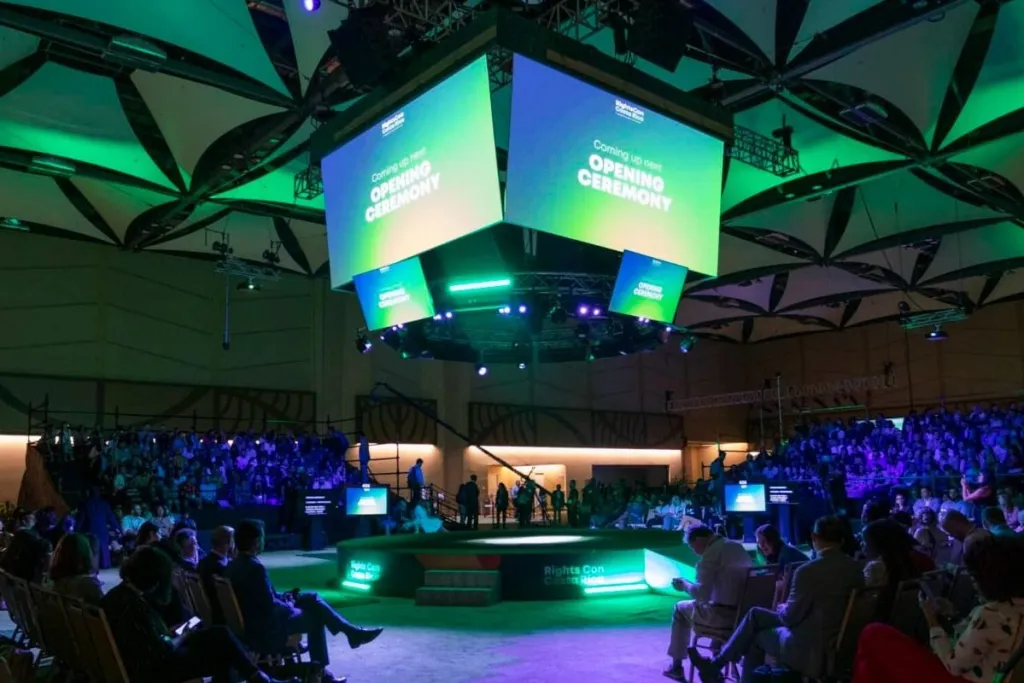
The 2026 edition was meant to be the first-ever RightsCon in southern Africa — a “long-awaited return to the African continent” for African community members shut out of the 2023 Costa Rica event due to visa issues.
Zambia’s visa-free access for 167 nationalities was a key reason it was chosen as host. Ironically, it was procedural issues that were first cited as grounds for the cancellation.
The financial toll is significant: estimating 2,000 international attendees spending $450 daily for four nights equals $3.6 million in lost direct spend alone.
The damage to the destination’s tourism brand could be even greater, making this a cautionary tale for event organizers navigating geopolitical risk.
Why Zambia Was Selected
Lusaka rarely hosts international conferences — it hosted just three association meetings with 50+ participants in 2024, per the latest ICCA data.
Access Now announced Lusaka as the host city in a blog post in July of 2025, describing a multi-year, multi-stakeholder selection process that prioritized participant safety and aimed to “uphold RightsCon as a trusted and crucial space that drives the global digital rights agenda forward.”
It praised the “strength, resilience, and global significance of Africa’s digital rights community” and cited Zambia’s progress on connectivity, digital literacy, and civic freedoms — including its “stable political context and a consistent record on civic freedoms.”
Yet organizers also noted that Zambia “faces considerable challenges in safeguarding human rights amidst rapid digital transformation” — a tension that made it an ideal venue to “spotlight the vital work of local and regional civil society in advancing digital rights, often under difficult conditions.”
In April 2025, Zambia enacted a Cyber Crimes Act and a Cyber Security Act — laws the of Democracy called a rebranding of repression, warning they grant the regime “sweeping powers to criminalize dissent, chill legitimate speech, and enable intrusive data collection” and “lack adequate human-rights safeguards.”
Working With Local Government
The Zambian government publicly backed the event throughout the process. Access Now says it visited the country in 2024 and returned for two additional site visits, all coordinated closely with Government of Zambia officials and including the public signing of an MoU with the Ministry of Technology and Science (MoTS).
The MoTS published an article regarding the March 3 meeting with Access Now, stating that “the conference is expected not only to strengthen global dialog on digital rights but also to contribute meaningfully to Zambia’s economic growth, tourism development, and digital inclusion agenda.”
As recent as Sunday, official news stories reflected support from the government.
Governmental Support Withdrawn
This week everything changed.
According to Access Now, their team arrived in Zambia on Sunday to start setting up. On Monday they got the first sign of the challenges ahead, a phone call from MoTS about an urgent issue. They were told that Chinese diplomats were putting pressure on the Government of Zambia because Taiwanese civil society participants were planning to join RightsCon in person.
Following this call, it opened communication channels with Taiwanese participants. It later received reports of immigration officers telling participants as they arrived that RightsCon had been cancelled.
On Tuesday without any prior communication with Access Now, the Zambia National Broadcasting Corporation (ZNBC) shared a statement from Technology and Science Minister Felix Mutati: “Certain invited speakers and participants remain subject to pending administrative and security clearances, which have not yet been concluded.” Mutati added that the “decision is purely procedural and consultative in nature and should not be interpreted as a withdrawal from engagement.”
Following this, organizers said they made several unsuccessful attempts to meet or establish two-way communication with government officials.
On Wednesday, Thabo Kawana, permanent secretary of Zambia’s Ministry of Information and Media, issued a press statement apologizing for inconvenience and offering additional context.“The postponement was necessitated by the need for comprehensive disclosure of critical information relating to the key thematic issues proposed for discussion during the Summit. Such disclosure is essential to ensure a full alignment with Zambia’s National values, policy priorities, and broader public interest considerations.“
That same day, Access Now announced that RightsCon 2026 would not proceed in Zambia or online. It did not share any details about the cancellation, but discouraged participants from traveling to Lusaka for the event.
UNESCO’s World Press Freedom Day 2026 Global Conference, set to run concurrently with RightsCon, has been “adjusted” to primarily online, with a Lusaka event on May 4. The UNESCO/Guillermo Cano World Press Freedom Prize ceremony will move to UNESCO Headquarters in Paris at a later date.
The Impact of Chinese Influence
Even before Access Now shared its behind-the-scenes account of the last week, several community members and observers had blamed the event’s cancellation on pressure from China — stemming from its tense relationship with Taiwan, where the last edition of RightsCon was held.
On Thursday, local investigative news publication News Diggers! published a story citing “well-placed sources” that RightsCon was cancelled because the program featured “Taiwanese delegates who would potentially speak against China at a venue donated by the Chinese government.”
The cancelled event’s main venue, the Mulungushi International Conference Center, underwent a major expansion that concluded in 2022. The expansion was funded in part with a $30 million Chinese government grant, per research lab AidData — one of many Chinese investments in Zambia. Last week, the two countries confirmed a $1.5 billion energy deal.
Bethany Allen, head of China investigations at the Australian Strategic Policy Institute (ASPI), posted on X said “people close to the matter believe that the Chinese consulate was demanding information on Taiwanese participants and programming related to Taiwan.”
Thor Halvorssen, CEO of the Human Rights Foundation (which runs the Oslo Freedom Forum), reposted Allen’s post and added a scathing comment. “The authoritarians who rule China are so desperately afraid of the power of freedom of speech that they marshaled an entire African government to utterly burn its own credibility in this mess.”
Chinese human rights researcher Yaqiu Wang praised organizers for convening in the Global South, but warned that China’s influence operates beneath the surface, despite its “non-interference” policy.
Last week, The Guardian reported that Taiwan President Lai Ching-te cancelled his trip to Eswatini — Taiwan’s only African diplomatic ally — after several countries revoked overflight permits under ‘intense pressure’ from China.
Zambia also appears to be under pressure from the U.S. In March, The New York Times reported that the State Department is considering withholding lifesaving assistance to people with H.I.V. in Zambia as a negotiating tactic to give the U.S. more access to the country’s critical minerals.
Human Rights Activists Respond
“The Zambian government clearly didn’t want us there. I’m going to call their intervention out for what it is – censorship,” said Index on Censorship CEO Jemimah Steinfeld in a blog post titled “Zambia censors an international conference…on censorship.”
Gina Romero, the United Nations Special Rapporteur on the Rights to Freedom of Peaceful Assembly and of Association, shared her concerns called the Zambian government’s actions a “de facto cancellation” and a “clear violation of the rights to freedom of assembly, association and expression, and a deliberate attack on civic space.” Romero also shared concerns around compulsory government accreditation for World Press Freedom Day attendees. “The right to assemble must not be conditioned upon the disclosure of sensitive information or the surveillance of those convening.”
The Net Rights Coalition, backed by 132 digital rights stakeholders, issued a statement condemning the Zambian government’s “abrupt disruption” of RightsCon and raising alarm about “closing civic space and fostering a culture of self-censorship ahead of the August 2026 elections.”
“The Zambia government’s flimsy reasons for postponing RightsCon suggest that the government wanted to control the summit’s human rights agenda. The authorities should fully explain the last-minute cancellation, which is a serious loss for the promotion of human rights,” said Idriss Ali Nassah, senior Africa researcher at Human Rights Watch.
Adwoa Ankoma, a policy strategist, attorney, and Fulbright fellow, commended the attempt to host RightsCon in Zambia. “The attempt itself was significant. Choosing Zambia as host wasn’t the easy route. It was a statement.” She ended with a plea for more of this type of initiative. “That’s where change actually happens. I hope this doesn’t become a lesson in playing it safe next time. The boldness of the attempt is worth preserving, even when it doesn’t land.”
RightsCon 2025 was also impacted by U.S. policies. The Trump administration’s January 2025 executive orders that halted foreign aid spending and paused existing grants and contracts resulted in an increase in cancellations, pivots to online participation, and below expected registrations.
The event originally launched in San Francisco in 2011 with around 400 participants and has since traveled to Rio de Janeiro, Manila, Brussels, Toronto, Tunis, San Jose, and Taipei.
Access Now said its commitment to its mission and the movement is stronger than ever and launched a survey for community members to report financial implications of the cancellation, and share their thoughts on how future editions should be planned.
👇Follow more 👇
👉 bdphone.com
👉 ultractivation.com
👉 trainingreferral.com
👉 shaplafood.com
👉 bangladeshi.help
👉 www.forexdhaka.com
👉 uncommunication.com
👉 ultra-sim.com
👉 forexdhaka.com
👉 ultrafxfund.com
👉 bdphoneonline.com
👉 dailyadvice.us